

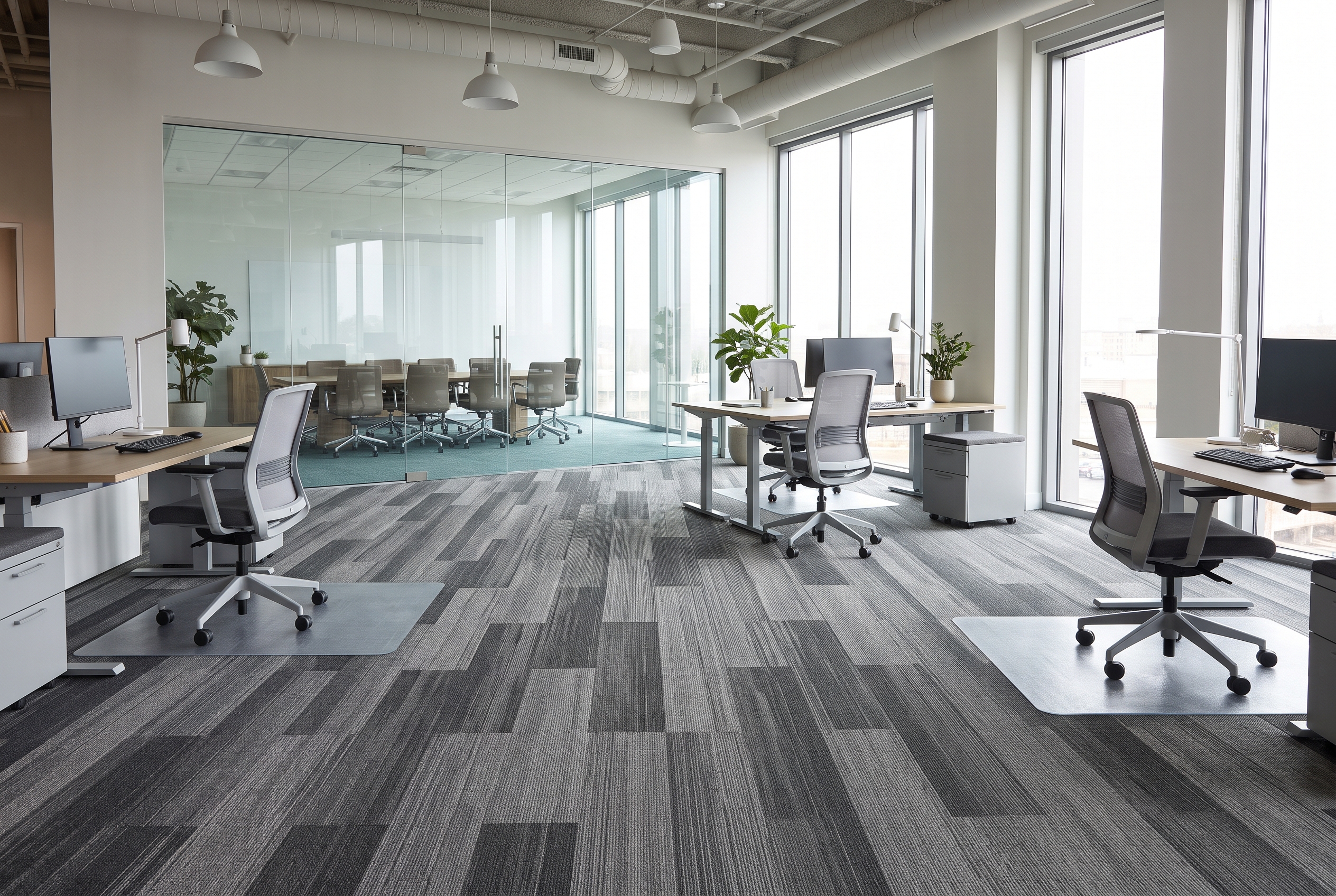
How to Choose Commercial Carpet for Your Business
The commercial carpet that lasts is solution-dyed nylon in a low, dense loop or a patterned loop. Lay it as carpet tile where chairs roll, spills happen or the layout will change. Lay it as broadloom where an unbroken, quieter floor matters more than swapping a square, such as a boardroom or a sanctuary. From there, the right carpet for each room depends on its traffic, the fire rating its corridors need, and the cleaning schedule you can keep.
| Space | Tile or broadloom | Construction |
|---|---|---|
| Open offices and corridors | Carpet tile | Low, dense loop |
| Private offices and boardrooms | Broadloom or tile | Cut pile or cut-and-loop |
| Lobbies and entries | Tile, with a walk-off zone | Low loop, darker pattern |
| Classrooms and daycares | Carpet tile | Low loop, moisture-barrier back |
| Sanctuaries and event halls | Broadloom or large tiles | Loop or cut-and-loop pattern |
| Medical waiting rooms | Carpet tile | Low loop, moisture-barrier back |
| Restaurant dining rooms | Patterned broadloom or tile | Patterned loop or cut-and-loop |
| Retail sales floors | Carpet tile | Low, dense loop |
Carpet Tile or Broadloom for Your Space
If your space has rolling chairs, regular spills, cabling under the floor or a layout that will change, carpet tile is the better choice. If you want a floor with few seams, a large pattern or a softer feel, in a room where traffic is even and nothing gets moved, broadloom is.
Carpet tile's strength is that it comes apart. A stained or worn square is lifted and replaced, and tiles in a worn path can be swapped with tiles from under a desk. An office can be recarpeted with the furniture lifted on jacks rather than emptied out. By the Carpet and Rug Institute's (CRI) account, a whole office can often be done in one overnight shift, and the reduced disruption often makes up for tile's higher cost for the product and installation.
Broadloom's strength is that it does not come apart. It comes in rolls 12, 13.5 or 15 feet wide, so a room has few seams, and it carries large pattern repeats that tile cannot. Over a cushion it feels softer and sounds quieter, which suits a boardroom, a sanctuary or a hotel corridor where the look matters as much as the wear. Narrow six-foot rolls are made for corridors, where a full-width roll would waste carpet.
The carpet tile we carry comes in squares and plank-shaped tiles, in loop, patterned and tufted constructions, so a tile floor no longer has to look like a checkerboard. If you are still weighing carpet against a hard floor for parts of the building, carpet tile and luxury vinyl each win different rooms, often in the same suite.
Why Solution-Dyed Nylon Is the Commercial Standard
For most businesses, the fiber to buy is solution-dyed nylon. Nylon springs back under heavy foot traffic better than the other synthetic fibers, and it is the workhorse of commercial carpet for that reason. Solution dyeing is what makes its color last.
Solution-dyed means the color is added to the nylon while it is still molten, before it is spun into fiber. The color runs all the way through each strand rather than sitting on its surface, so it resists fading and color loss far better than carpet dyed after it is made. A bleach spill or years of afternoon sun through a storefront window leaves a solution-dyed carpet looking like the day it went in.
Polyester costs less and resists stains well, and it suits a low-traffic office or a budget-driven space where nothing rolls. Wool belongs to upscale hospitality, where its look and feel justify the price. For a business floor that has to take real traffic, the commercial carpet in our catalog is where to start.
Commercial carpet also differs from residential carpet in how it is built. It is lower, denser and tighter, made to glue down to a slab and take rolling traffic, where a home carpet is taller and softer over a pad. A plush residential carpet in a busy office crushes in its traffic lanes quickly.
Loop, Cut Pile or Pattern
In corridors, lobbies, open offices, classrooms and patient care areas, a low, dense loop is the construction that lasts. It keeps its appearance under constant feet, and it gives wheelchairs and carts a smooth, firm surface to roll on.
Cut pile, where the tops of the yarn loops are sheared open, gives a softer, richer look and belongs in lower-traffic rooms. Administration areas, libraries, private offices and boardrooms are the places for cut pile or cut-and-loop styles, and a law office or an executive suite is the classic fit.
A multi-level loop or a cut-and-loop pattern also hides soil, spots and traffic wear far better than a flat, solid color. Restaurant dining rooms and hotel corridors carry busy patterns for that reason. Our carpet tile runs from quiet textures to bold geometric designs, Art Deco included, so a pattern can be chosen for looks and for the soil it hides.
Reading a Commercial Carpet Spec
Density is the first number to check on a commercial carpet spec, and face weight the second. Density is how much yarn is packed into a given volume of carpet. It is the key to performance under heavy traffic, because a carpet that is not dense enough crushes no matter how heavy it is.
Face weight, also called pile yarn weight, is the ounces of yarn per square yard. Shoppers fixate on it, but a tall, loose carpet can be heavy and still crush, while a short, tight one with less yarn outlasts it.
Gauge and stitches per inch describe how closely the tufts are set across and along the carpet. Together with the yarn, they produce the density. Pile height is the height of the yarn above the backing.
| Spec | What it means | What heavy traffic usually gets |
|---|---|---|
| Fiber | What the yarn is made of | Solution-dyed nylon |
| Construction | Loop, cut or both | Low, dense loop |
| Average pile yarn density | Yarn packed per volume | 6,000 or more |
| Pile yarn (face) weight | Ounces of yarn per square yard | About 24 oz |
| Pile height | Yarn height above backing | Low, about 0.15 inch |
| Backing | What holds the tufts | Hardback or unitary |
Those heavy-traffic figures come from a case study CRI uses to show a high-performance spec: tufted loop pile, solution-dyed nylon, a 0.156-inch pile, 24 ounces of yarn and an average pile yarn density of 6,000 or more. They picture a carpet built for extreme traffic, not a legal minimum. An office or a classroom can do well with a lighter spec built the same way.
Backing, Cushion and How Commercial Carpet Is Installed
Most commercial carpet is glued straight to the slab, with no pad. Carpet tile goes down on a thin film of releasable adhesive that holds each tile in place but lets it be lifted later. Broadloom is either glued directly or glued to a cushion that is itself glued to the floor.
Carpet tile has its backing built in. Hard backings of PVC, polyester or polyethylene keep tiles square and their edges tight. Some backings also act as a moisture barrier that stops a spill from soaking through to the slab, which matters in healthcare spaces. Cushion-backed tiles exist where comfort underfoot matters more than rolling ease, and a separate pad never goes under carpet tile.
The installation standard CRI 104 sets the conditions that make a commercial carpet installation last. The carpet sits in the space for at least 24 hours at 65 to 95 F.
The room is then held in that range at no more than 65 percent humidity before and after the job. The slab is tested for moisture and alkalinity before anything is glued to it. And where a cushion goes under commercial carpet, it is no thicker than 3/8 inch.
Tiles can be laid monolithic, with every tile pointing the same way like broadloom; quarter turn, alternating direction for a checkerboard texture; or ashlar, offset like brick. The maker of each tile says which layouts it allows. Because tile goes in around lifted furniture, replacing a business floor in phases, after hours, is easier with tile than with any other floor.
Fire Ratings, Indoor Air and Accessibility
Every carpet sold in the U.S. already passes a basic federal flammability test, the "pill test," so the fire question for a business is about corridors and exits. There, depending on the building's use and the fire code it follows, the carpet may need a flooring radiant panel rating.
The radiant panel test measures how much heat it takes to keep a flame spreading across a floor. CRI's summary of the code limits puts Class I, the higher rating, in the corridors and exits of hospitals and nursing homes. Class II covers the corridors of day care centers, hotels, dormitories and apartment buildings. Those limits apply where the building has no sprinklers, and most codes ask for the rating only in corridors and exitways, not inside rooms.
Offices, stores and houses of worship are not on either list. Whether their corridors need a rating depends on the code your local building or fire official enforces, and the data sheet for any commercial carpet shows its class either way, so the answer is on paper before the carpet is ordered.
For indoor air, CRI's Green Label Plus program tests carpet, cushion and adhesives for very low emissions of volatile organic compounds, and the EPA recognizes it in its recommendations for federal purchasing. Look for the label on both the carpet and the adhesive.
For accessibility, the ADA Standards require carpet in public spaces to be securely attached, with a firm backing or no pad at all, a pile no taller than 1/2 inch, and exposed edges fastened down with trim. The standard's advisory note adds that a lower pile and no pad make a wheelchair easier to push, one more reason low loop carpet tile is so common in public buildings.
Which Commercial Carpet for Which Space
Every room in a business asks a different thing of its carpet, so the spec changes from the office to the lobby to the boardroom. Each industry weighs carpet against hard flooring differently, and where carpet is the answer, these are the choices that hold up.
Offices and Conference Rooms
In offices, carpet tile in a low, dense loop is the default for open work areas and corridors. Chairs roll, cables run under the floor and the layout changes every few years, and tile handles all three. Tiles under the desks can be swapped with tiles from the traffic paths as the paths wear.
Conference rooms and private offices can take a step up: a cut-and-loop pattern or a cut pile for a richer look, in tile or broadloom. Chair mats under desk chairs protect any carpet, and they matter most on cut pile.
Churches, Event Halls and Fellowship Spaces
In churches, the sanctuary usually gets broadloom or large-format tile for a quiet look with few seams, and the carpet softens the sound of a full room. A loop or patterned loop in the aisles and at the entries takes the heaviest foot traffic of the week in a few hours on a Sunday.
Fellowship halls and event rooms are a different floor. Where coffee, food and folding tables move every week, carpet tile in a patterned loop can be spot-replaced, and the kitchen itself belongs on a hard surface.
Schools, Daycares and Classrooms
In schools, daycares and classrooms, carpet tile with a moisture-barrier backing is the practical choice. Spills are constant, children sit on the floor, and a stained or worn tile can be replaced during a school break without recarpeting the room.
A low loop in a darker or patterned color hides the soil of a school day. Keep carpet out of art and wet areas, where a hard floor is easier to clean, and use it in reading corners and circle-time areas where its softness and quiet are the point.
Medical Offices and Clinics
In medical offices and clinics, carpet belongs in the waiting room, the administrative offices and some corridors, while exam and treatment rooms usually take a hard surface. Where carpet is used, carpet tile with a moisture-barrier backing keeps spills from reaching the slab.
Wheelchairs and walkers make a low, dense loop the right construction, and the ADA's 1/2-inch pile limit and firm-backing rule apply in every public area of a clinic. If a corridor is part of an exit route, check the radiant panel class your building needs.
Restaurants, Hotels and Hospitality
In restaurants, hotels and banquet rooms, a patterned carpet in solution-dyed nylon earns its place. The pattern hides spills and traffic, and solution dyeing lets the floor be cleaned hard without fading. Broadloom carries the large patterns hospitality design favors, while tile makes spot replacement easy.
Carpet stops at the kitchen door and the service side of the bar, where grease and water need a hard floor. Hotel corridors are often exit routes, so the radiant panel class matters there too.
Retail Stores and Entries
In retail stores, carpet tile in a low, dense loop handles shoppers and stocking carts on the sales floor and can be reworked when the layout changes. Fitting rooms and quieter departments can take a softer cut pile.
The entry is where a store's carpet is won or lost. A good entrance system has three parts: a scraper mat outside, a mat inside the door, and a walk-off zone running 10 to 15 feet into the building to catch the rest of the soil and moisture. Through a Michiana winter, that inside zone stops salt and slush before they reach the sales floor, and walk-off carpet tile makes it part of the floor rather than a loose mat.
What Commercial Carpet Costs
Carpet costs about $3 to $11 a square foot installed nationally, roughly $27 to $99 a square yard. That range is This Old House's, built on Angi and HomeAdvisor data, and it puts nylon carpet itself at $2 to $5 a square foot and polyester at $1 to $3, with installation labor at $0.50 to $1.
| Item | National range |
|---|---|
| Carpet installed | $3 to $11 per sq ft ($27 to $99 per sq yd) |
| Nylon carpet, material | $2 to $5 per sq ft |
| Polyester carpet, material | $1 to $3 per sq ft |
| Installation labor | $0.50 to $1 per sq ft |
| Pad, where used | $0.75 to $2 per sq ft |
| Old carpet removal | Adds $2 to $3 per sq ft |
Commercial carpet tile is not broken out in those guides, and the trade's own view is the honest one. Tile usually costs more for the product and the installation than broadloom, and the time it saves, in overnight installs and single-tile repairs, often makes up the difference. Broadloom looks cheaper on the quote and costs more when a stain or a worn lane means replacing a whole room.
What moves a commercial carpet price most is the spec, since solution-dyed nylon and higher density cost more. After that come the slab prep and moisture testing, how much furniture has to be moved or lifted, after-hours work, and how much old flooring comes up. The price for your space comes from measuring it and seeing the slab.
Keeping Commercial Carpet Looking New
Keeping commercial carpet looking new comes down to cleaning on a schedule: stop soil at the door, vacuum it out before it grinds in, and deep clean before the carpet looks dirty. The vacuuming frequency rises with the traffic, and this routine reflects that:
- Build an entrance system: a scraper mat outside, a mat inside, and 10 to 15 feet of walk-off carpet inside the door.
- Vacuum daily in high-traffic areas, twice a week in medium traffic and weekly in light traffic, with a vacuum certified under CRI's Seal of Approval program.
- Blot spills right away with a clean white cloth; do not scrub, which frays the pile.
- Deep clean with hot-water extraction at least every 12 to 18 months, and more often in high-traffic areas.
- Through salt season, vacuum the entry zones more than once a day and extract them more often, since salt residue holds soil.
- Rotate or replace worn carpet tiles from the traffic paths before the wear spreads.
The schedule matters more than any single cleaning. A carpet vacuumed every day in its traffic lanes stays ahead of the soil, while one cleaned only when it looks dirty has already lost some of its pile.
When Commercial Carpet Needs Replacing
Commercial carpet needs replacing when its traffic lanes are crushed or worn through, when stains wick back up after every cleaning, or when the backing lets go. Short of those, much of the trouble a business sees can be repaired.
Worn paths in carpet tile are the easy case: lift the worn tiles and set in spares, or rotate tiles from under desks. Ripples or bubbles in broadloom usually mean the carpet has come loose from its adhesive or, over a cushion, lost its stretch, and the fix is re-adhering or re-stretching that area. Curling carpet tiles usually point to moisture from the slab or to adhesive that failed, and the slab is tested before the tiles go back down.
When the backing itself breaks down, the carpet delaminates, with the face pulling away from the back, and replacement is the only fix. The same is true when a solid-colored broadloom has worn through in its lanes while the rest of the room still looks new. That is the case where carpet tile pays for itself the next time around.
Commercial Carpet From Comfort Flooring
At Comfort Flooring, we sell and install commercial carpet and carpet tile for businesses across Michiana and Southern Michigan, from offices and retail stores to healthcare facilities, assisted living communities and restaurants. Our commercial lines include Aladdin Commercial, Philadelphia Commercial and Pentz, in broadloom and tile.
We install commercial carpet and carpet tile along with luxury vinyl, ceramic and porcelain tile and other hard floors, so the carpeted offices and the hard-surface break room can be one job. When old carpet comes up, our crews haul it away.
When you are ready, we come out, measure the space and price the carpet it needs.
Commercial Carpet Questions We Hear
Can Commercial Carpet Go in a Home or Basement?
Yes, commercial carpet works well in a home basement, playroom or home office. A low loop is firmer and less plush than residential carpet, and carpet tile in a basement can be lifted and dried if water ever gets in.
It will not feel like a bedroom carpet over a pad. For a family room where you sit on the floor, a residential carpet is softer; for a hard-working basement, commercial carpet tile is the practical choice.
Can You Replace One Carpet Tile?
Yes, replacing a single carpet tile is one of tile's biggest advantages. The tile lifts from its releasable adhesive and a spare goes in its place, ideally from the same dye lot so the color matches.
Keep a few cartons of spares from the original order, stored flat, for those repairs. Rotating tiles from under furniture into worn paths extends the floor's life before you need any spares at all.
How Long Does Commercial Carpet Installation Take?
Commercial carpet installation takes from one overnight shift to several days. An office in carpet tile can often be done overnight, with furniture lifted on jacks and the tiles slid underneath, while broadloom glue-down takes longer because furniture has to come out and the adhesive has to set.
Plan for the carpet to sit in the space for a day before installation so it reaches room temperature, and for the slab to be tested before that.
Do Carpet Tiles Need a Pad?
No, carpet tiles do not take a separate pad. The backing is built into each tile, and the tiles go down on adhesive directly over the slab or subfloor, which keeps them flat and lets them be lifted one at a time.
Where more comfort is wanted, cushion-backed tiles have the cushion built in. In public spaces, the ADA asks for a firm backing or none, so a soft pad under carpet works against the rule.
How Much Extra Carpet Tile Should You Order?
Order enough extra carpet tile to cover cuts at the walls plus a stock of spares, usually 5 to 10 percent over the measured area. The spares, sometimes called attic stock, should come from the same dye lot as the floor.
A tile bought years later from a new dye lot can differ in shade. Spares stored from the original order are what make single-tile repairs invisible.
Planning Your Floor With Us
The right commercial carpet is the one matched room by room to its traffic, its fire and accessibility rules, and the cleaning you will actually do. Bring us your floor plan and a sense of how each room is used, and set up a free estimate so we can measure the space and price it.


