

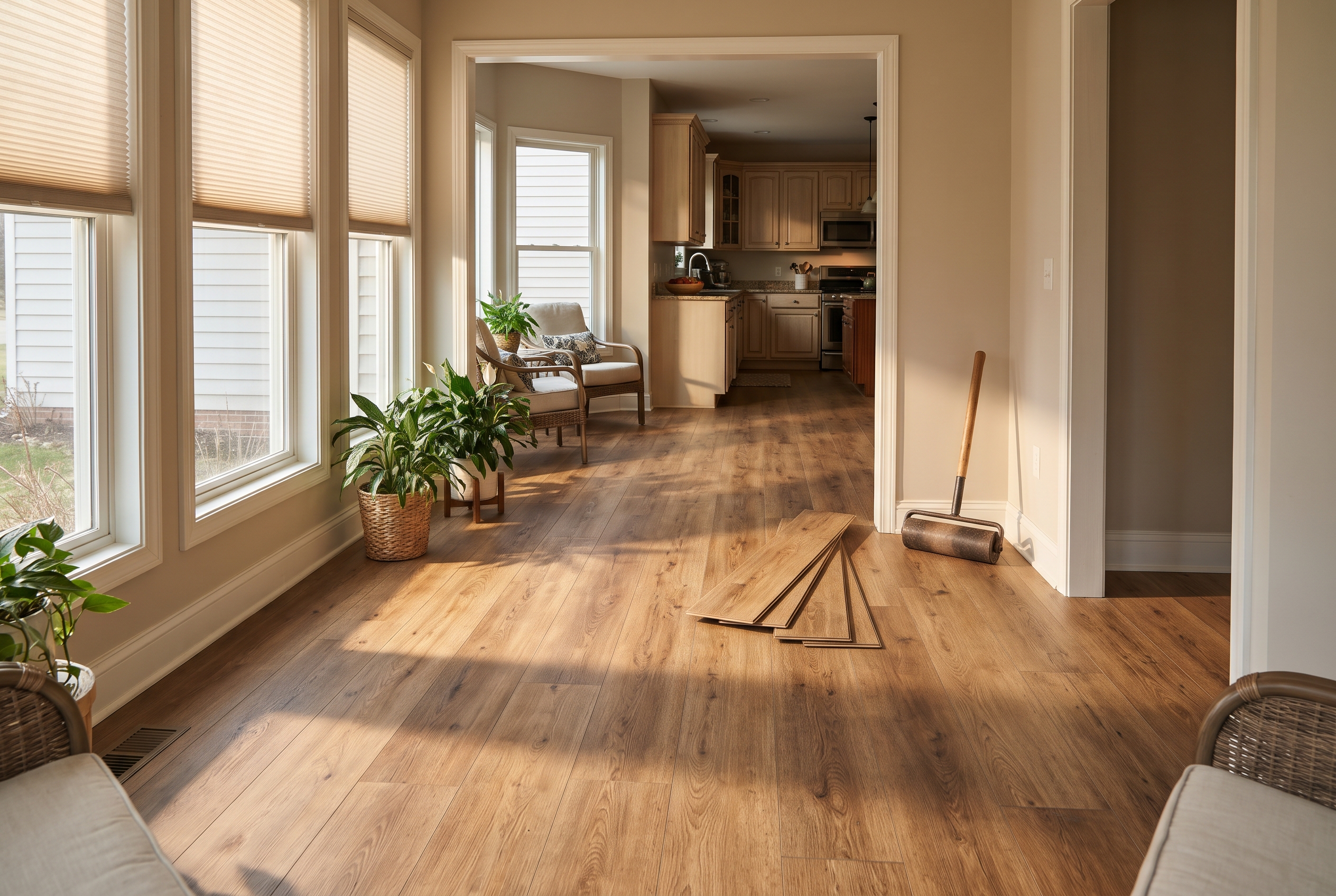
Most homes are best served by click-lock vinyl plank, which floats over the subfloor, goes down fast and can come back up. Glue-down earns its place where a floating floor would be pinned or pushed around: under a heavy island, in a room that bakes in the sun, on stairs, across a long open plan, and in a business with carts and rolling chairs. The choice comes with the product, because glue-down and click-lock planks are built differently.
| Situation | Better method | Why |
|---|---|---|
| Bedrooms, living rooms, most kitchens | Click-lock | Fast, forgiving, removable |
| Over one layer of old vinyl or tile | Click-lock | Floats over it, no tear-out |
| Upstairs over a wood subfloor | Click-lock | Attached pad softens footfall |
| Island set on the finished floor | Glue-down | Weight would pin a floating floor |
| Sunroom or big west windows | Glue-down | Heat moves a floating floor |
| Open plan longer than 50 feet | Glue-down | No break needed |
| Stairs | Glue-down | Treads must be fastened |
| Office chairs, carts, store aisles | Glue-down | Rolling loads shift floating floors |
| Basement slab | Either, after a moisture test | Glued planks can allow a damper slab |
How Click-Lock and Glue-Down Planks Hold a Floor Down
A click-lock plank has a locking edge on all four sides, so the planks join into one sheet that rests on the subfloor without being attached to it. A glue-down plank, often called dryback, is thinner and more flexible, has no locking edge, and is bonded to the subfloor across its whole back.
Because a click-lock floor floats, it moves a little with the seasons as one piece. The planks usually have a rigid stone-plastic (SPC) or wood-plastic (WPC) core, and many come with a pad attached underneath. The floor needs a gap of about 1/4 inch at every wall so it can move, and nothing is ever nailed, screwed or caulked through it. The baseboard or quarter round covers the gap and is fastened to the wall.
Because a glue-down floor is bonded, it stays where it was laid. The adhesive is usually a hard-set acrylic in homes and light commercial spaces, or a two-part epoxy where heavy carts roll all day. Some glue-down planks use a pressure-sensitive adhesive that stays tacky, which makes a single plank easier to pull and replace later. Every glue-down floor is rolled once it is down, to press the planks into the adhesive.
You choose the method when you choose the plank, not on install day. The method is printed on the carton and the spec sheet, and a click-lock plank is not glued in place of a glue-down one, or the other way around.
Where Click-Lock Vinyl Plank Works Best
If you are flooring bedrooms, a living room or a kitchen where the cabinets are already in, click-lock is the better choice for most homes and the easier one for a DIY project. It goes down faster, forgives more of the subfloor and comes back up whole if it ever has to.
Click-lock also costs less to install, and it can usually float over one layer of old vinyl, tile or hardwood that is flat and firmly stuck down. That saves the cost and mess of tearing out an old floor. It is also the gentler choice over old sheet vinyl that might contain asbestos, since the EPA's advice is to cover such a floor rather than disturb it.
An attached pad softens footfall and takes the edge off the hard sound of vinyl. And because nothing is glued, a click-lock floor can come up later without anyone scraping adhesive off the subfloor.
A click-lock floor needs the room on its side. The subfloor has to be flat within about 3/16 inch over 10 feet, the house has to stay heated above about 55 F, and the floor has to be free to move, with no cabinets on top, a gap at every wall and runs kept within the plank's limit.
The click-lock planks we carry include Mannington's ADURA Max and ADURA Apex and COREtec, in wear layers from entry grade to commercial.
When Glue-Down Vinyl Plank Is Worth It
Glue-down is worth it when something in the room would push, pin or bake a floating floor: carts and rolling chairs, a heavy island, strong sun, a long open run or a flight of stairs. A bonded floor does not move as a sheet, so none of those can shift it.
A glued floor has other strengths as well. A damaged plank comes out on its own without disturbing its neighbors. The floor runs from room to room without a transition strip. And it copes with heat that would buckle a floating floor; Mannington suggests its glue option wherever direct sun can push the floor past 140 F.
Glue-down asks more of the subfloor in return. A glued plank is thin and follows whatever is under it, so the subfloor has to be flatter, cleaner and smoother than for a floating floor, and old vinyl usually comes out first. The slab has to be dry enough for the adhesive, the room is held at living temperature for two days before the job, and the adhesive is the one the plank's maker names.
The glue-down planks we carry are mostly Mannington ADURA Flex and commercial lines from Aladdin Commercial and Philadelphia Commercial.
Which Method for Which Room
Most rooms in a house can take either method, so the room-by-room choice turns on what in that room would move, pin or wet a floating floor. In a bedroom or a den, nothing does, and click-lock wins on cost. The answer changes in the kitchen, the basement, the sunroom, the open plan, the stairs and the bath.
Kitchens With an Island or Heavy Cabinets
In a kitchen where the cabinets and island are set first, a click-lock floor runs up to them with its gap and works well. A floating floor is not made to carry cabinets or an island on top of it.
A cabinet run or an island sitting on a floating floor holds it in place with its weight, so when the rest of the floor moves with the seasons it has nowhere to go but up. The strain shows as a ridge somewhere else in the room, often at a doorway or along a wall.
In a remodel, set the cabinets first and the floor second. If the island has to sit on the finished floor, glue the kitchen. A glued zone under the island can meet a floating section, but the floating side keeps its own gap at that line and a transition covers it, so in an open kitchen gluing the whole room usually looks better. A freestanding table, a range or a refrigerator is fine on a floating floor, as long as appliances roll in on a hand truck over sheets of hardboard.
Basements and Concrete Slabs
Both methods work in a basement over a concrete slab that passes its moisture test, and the glued plank can often take the damper slab. Under its glue-down ADURA Flex set in M-Grip adhesive, Mannington accepts concrete up to 95 percent relative humidity; under its floating ADURA Max, the line is 85 percent.
Those limits are read with the ASTM F2170 test, in which a probe sits in a hole drilled partway into the concrete until the reading settles. A handheld meter pressed against the surface reads something else, so it cannot tell you whether a slab passes. Test first, then choose the method.
The result runs against the common belief that a floating floor is the safer choice on a damp slab. Mannington also does not recommend 6-mil plastic sheeting directly under its floating planks. A slab over the limit for either method needs more drying time or a moisture-mitigation coating before any plank goes down.
Neither method fixes a wet slab. A waterproof plank shrugs off a spill on its surface, but water coming up through the concrete still has to be dealt with first. Below grade, choose from the waterproof planks in our catalog, glued or clicked, once the slab has passed.
Sunrooms and Rooms With Big Windows
In a sunroom, or any of the rooms with big windows that bake in the afternoon sun, glue-down is the safer method, or at least a floating floor with good blinds. Heat makes a floating floor grow, and where sun pours through a big west or south window onto one part of the floor, that part expands while the shaded part does not, until the floor buckles. A glued plank is held down along its whole length, so it stays flat.
Sun also fades vinyl over time, whichever method holds it down. Blinds, curtains or a UV-blocking window film during the strongest afternoon hours protect the color as well as the floor's shape.
A three-season room is a different problem. Vinyl plank of either kind wants a room that stays above about 55 F, and an unheated sunroom in a Michiana January falls far below that. Heat the room through the winter, or choose a floor made for those temperatures. In a heated sunroom, a glue-down plank with a click-lock twin lets the floor carry on into the next room in the same color.
Open Floor Plans and Long Runs
An open floor plan is where glue-down often wins, because a floating floor needs a break once a run gets long and a glued floor does not. On ADURA Max, the limit is 50 feet in either direction or 2,500 square feet.
The break is a T-molding that lets each section move on its own. In a house with doorways it sits in a doorway and hardly shows. In an open plan where the kitchen, dining room and living room are one space, it becomes a strip across the middle of the floor.
Measure the longest run before you choose. If it is over the plank's limit and there is no doorway to hide a break, glue the floor, or choose a floating plank whose maker allows a longer run.
Stairs
Stairs are always glued, whatever method the rest of the floor uses. A step takes the full force of every footfall at its front edge, and a plank that could shift there is a fall waiting to happen, so every tread is fastened.
A stair is built from three glued pieces: the tread, the riser and a stair nose over the front edge. Most floating lines make a matching stair nose so the stairs carry the same look as the landing, and ADURA Max comes with flush and overlap versions.
Before you order, check that the plank you like has a matching stair nose, and count the steps, since stairs are priced by the step rather than by the square foot.
Bathrooms and Laundry Rooms
Bathrooms and laundry rooms can take either method, and the choice usually follows the rest of the floor. A floating floor runs under the toilet with its gap, and the edges at the tub and the toilet flange are sealed with 100 percent silicone so water cannot get under them.
A glued floor suits a small bath where the doorway height matters, since a glue-down plank is thinner and leaves less of a step down to the hall. In a laundry room, either method takes a washer and dryer; slide them in over hardboard so the feet do not gouge the planks.
Sound, Comfort and Feel Underfoot
A click-lock floor with an attached pad feels a little softer under foot, while a glued floor feels solid, like the subfloor itself. Which feels better is largely taste, and the sound of the floor is often what settles the choice between the two methods.
A floating floor over a dip in the subfloor can sound hollow and click where the joints flex. Over a flat subfloor it sounds like any hard floor. A glued floor never sounds hollow, because there is no space under it.
Upstairs and in condos, footfall noise carries down to the rooms underneath. An attached pad cuts that noise, and a plank with one does not get a second pad, since a soft double layer lets the joints flex. If your building has sound rules, compare them with the plank's sound rating before you buy.
The best test is your own feet. Stand on a floating sample and a glued sample in socks and in shoes, and tap each with a knuckle; the difference you hear on a sample is the difference you will hear at home.
Repairs, Replacement and Removal
Repairs are easier on a glued floor, where a damaged plank comes out on its own, while replacement on a click-lock floor usually means unclicking from the nearest wall or cutting the plank out and setting a new one in. Either way it is a repair rather than a new floor, as long as you kept a carton of spares.
To replace a glued plank, warm it until it is flexible, lift it with a putty knife, set the new plank in a thin coat of the same adhesive, then roll it and weight it until the adhesive takes hold.
Near a wall, a click-lock floor is unclicked row by row back to the damaged plank and clicked together again. In the middle of a room, the damaged plank is cut out, the new one has part of its locking edge trimmed so it can drop in, and its seams are sealed and weighted for about 15 minutes.
Removal is where the methods differ most. A click-lock floor lifts out in whole planks. A glued floor comes up in pieces and leaves adhesive that has to be scraped before the next floor goes down, which adds time and a removal line to any future project.
What Glue-Down and Click-Lock Cost
Glue-down usually costs more installed, even though the plank itself can cost less. This Old House puts click-lock vinyl plank at $1.39 to $5.99 a square foot for material and glue-down at $1.20 to $7.72, and calls glue-down the most expensive way to install vinyl plank, with labor closer to engineered wood than to click-lock.
Installed, national cost guides put a floating vinyl floor at about $4.50 to $8 a square foot and a glued one at about $5 to $10. The gap is labor and prep: the adhesive, the trowel and roller, the flatter subfloor a glued plank needs, and the old vinyl that has to come out first.
| Item | Click-lock | Glue-down |
|---|---|---|
| Plank, material only | $1.39 to $5.99 per sq ft | $1.20 to $7.72 per sq ft |
| Installed, national | About $4.50 to $8 per sq ft | About $5 to $10 per sq ft |
| Old vinyl or tile | One flat layer can stay | Usually comes out first |
| Subfloor prep | Flat within 3/16 in over 10 ft | Flatter and smoother still |
| Room back in use | Right away | Heavy items after a day |
On a real job, click-lock saves the most when it can float over an old floor, because that takes the tear-out line off the quote. Glue-down narrows the gap in a big open room, where it saves the transition pieces a floating floor would need. In a business it often wins outright, since a floating floor under carts costs more to fix later than the glue costs now. The price for your rooms comes from measuring them and seeing what is underneath.
Glue-Down vs. Click-Lock in Commercial Spaces
In a business with rolling chairs, carts or heavy foot traffic, glue-down is the standard and floating plank is the exception. Rolling loads push a floating floor a little with every pass, and over months the joints creep open or peak, while a bonded floor stays where it was put.
Commercial adhesives are made for that job, and the heaviest-duty ones are two-part epoxies rated for heavy rolling loads. Where traffic is light and nothing rolls all day, as in a small office, a boutique or an apartment unit, a floating plank with a commercial rating works well, especially with chair mats or soft casters under desk chairs.
We install luxury vinyl tile and plank for businesses as well as homes, and for a business the plank's commercial rating matters as much as the method.
Signs the Floor Needed the Other Method
A floating floor that peaks at an island, buckles by a sunny window or gaps across a long room was usually the wrong method for that spot. The fix is to free the floor, break the run or glue that zone, and it is rarely a whole new floor.
A ridge near an island or cabinet run means the floor is pinned. Cut the planks back from the cabinet to restore a gap, and if the island has to stay put, glue the planks in that zone.
Gaps or buckling near a big window come from heat. Blinds stop the damage from growing, and a floor that keeps moving there is better relaid as glue-down in that room.
Gaps that open across a long room in winter mean the run has no break. A T-molding at the nearest doorway lets each side move on its own.
On a glued floor, lifting edges or bubbles point to moisture from the slab or to adhesive that was past its working time. The slab is retested before the planks are re-glued, and a slab over the adhesive's limit gets a mitigation coating first.
Choosing Your Method With Comfort Flooring
At Comfort Flooring, we sell and install both glue-down and click-lock luxury vinyl, in homes across Michiana and in businesses from offices to assisted living communities. Our showrooms in Mishawaka and Elkhart are the place to stand on both and hear the difference before you choose.
Some lines come in both versions with the same look. Mannington's ADURA Flex and ADURA Max share many of the same visuals, so a sunroom or stairway can be glued and the rest of the house floated without the floor changing color at the doorway.
Our installers are licensed, insured and highly trained, and we install luxury vinyl tile and plank in homes and businesses alike. When you are ready, we come out, measure the rooms and price the method each one needs.
Glue-Down and Click-Lock Questions We Hear
Can You Glue Down Click-Lock Vinyl Plank?
No, a click-lock plank is not glued down for a normal floor. It is made to float, and gluing it pins the floor in place, so the locking edges can split as the rest of the floor tries to move with the seasons.
Stairs are the exception, since every tread is glued whatever the plank. For a glued floor, choose the glue-down twin of the plank instead; many lines offer one.
Does Glue-Down Vinyl Plank Need Underlayment?
No, glue-down vinyl plank does not take a foam or cork underlayment. It is bonded straight to a smooth subfloor, and any soft layer between the plank and the subfloor would let it flex, dent and show through the surface.
Over a rough wood subfloor, a thin wood underlayment panel goes down first to give the adhesive a smooth, solid surface. Over concrete, the slab is patched smooth instead.
Is Loose Lay the Same as Glue-Down?
No, loose lay is its own method. Loose lay planks are heavy and flexible, with a grippy back that holds them in place by weight and friction, sometimes with a little adhesive around the edges of the room.
Peel-and-stick planks are a third method, with adhesive already on the back. They are a small corner of the market and a different product from a troweled glue-down plank.
How Soon Can You Walk on Glue-Down Vinyl Plank?
You can walk on glue-down vinyl plank as soon as the floor is rolled, as long as it is light foot traffic. Heavy furniture waits at least 24 hours, and the floor is not washed for 48 hours while the adhesive sets.
Move appliances and heavy pieces back in on a hand truck over sheets of hardboard, and put felt pads or wide casters under them so they do not dent the planks.
Does Radiant Floor Heat Work With Both Methods?
Yes, radiant floor heat works with both methods when it is a hot-water system set in concrete and the floor's surface stays at or below 85 F. Electric heating mats are where the two methods part ways, and the plank's maker decides whether a mat is allowed.
Mannington allows electric mats under its floating ADURA Max only when the heating maker recommends and warrants them, and does not recommend heated mats under its glue-down ADURA Flex at all.
Can You Get the Same Look in Glue-Down and Click-Lock?
Yes, many lines offer the same look both ways. ADURA Flex and ADURA Max share many of the same colors and wood visuals, so you can glue one room and float the next without the floor changing at the doorway.
Check the stair nose and transition pieces too, so the edges match as well as the planks, and order both versions from the same color run where you can.
Is Glue-Down Vinyl Plank More Durable?
It depends on what the floor faces. The surface wears the same, because both methods use the same kind of wear layer, but glue-down is more stable under rolling loads and heat. In a business with carts, or a room that bakes in the sun, that stability is the durability that counts.
In a home, on a flat subfloor and in a heated room, both last as long as their wear layer. Durability there comes from the wear layer thickness and a flat subfloor more than from the method.
Seeing Both Side by Side
A glued plank and a click-lock plank look alike in a photo and feel different under foot, so it helps to stand on both before you decide. Bring a photo and the measurements of the room, and set up a free in-home measurement so we can price the method your rooms need.


